A Hearth in the Void: The Nuclear Dawn of Lunar Civilization
The Paradox of the Eternal Night
We often view the Moon as a static, silver sentinel—a silent witness to history that never changes. Yet, the greatest paradox of our era is that this ancient, lifeless rock is about to become the most technologically vibrant frontier in human history. What was once a destination for fleeting footprints is being reimagined as a permanent home. Through the International Lunar Research Station (ILRS), led by China and Russia, humanity is preparing to ignite a literal and metaphorical fire in the cold vacuum of space, bridging the gap between celestial observation and terrestrial habitation ↗handwiki.org.
The Vertigo of Scale
To stand on the lunar South Pole is to stand on the edge of a cosmic abyss, where the Earth is a fragile marble hanging in an infinite ink-black sea. The scale of the ILRS is equally staggering. This is not a single mission, but a decades-long symphony of engineering divided into three distinct movements:
- Reconnaissance (2021–2025): Establishing the groundwork through missions like Chang'e-6, which recently retrieved samples from the lunar far side to rewrite our understanding of volcanic history ↗news.cgtn.com.
- Construction (2026–2035): A frantic period of infrastructure deployment, including the Luna-26 orbiter in 2028 and the Luna-27 landings at the poles ↗indexbox.io.
- Utilization (2036 and beyond): The realization of a fully operational base by 2045, serving as a springboard for manned voyages to the red deserts of Mars ↗english.www.gov.cn.
A Nuclear Heart for the Moon
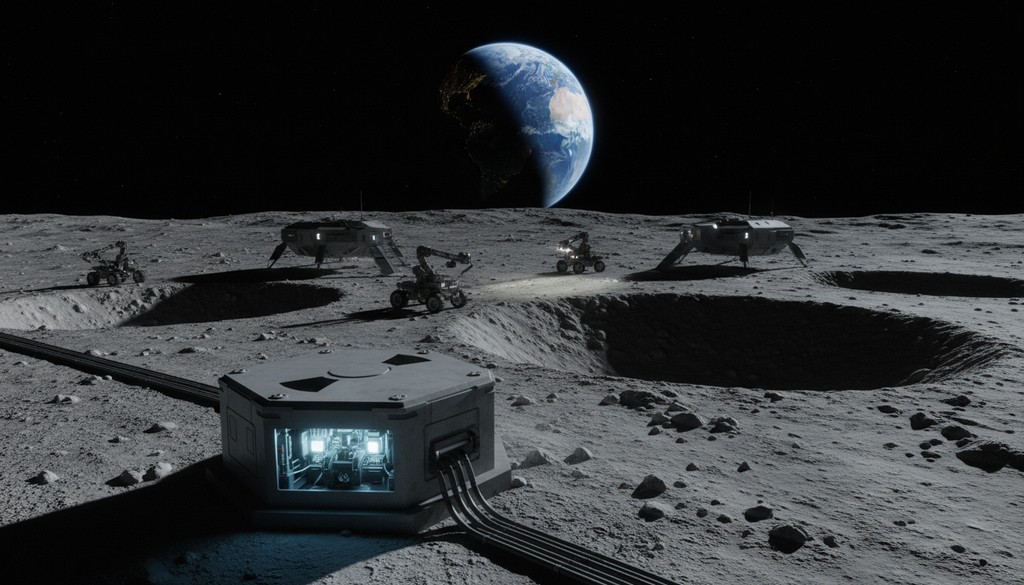
Because the lunar night lasts fourteen Earth days, solar power alone cannot sustain a civilization. To solve this, Russia and China are developing the "Selena" nuclear power plant, a small but mighty reactor designed to be delivered by 2035 ↗indexbox.io. This nuclear heart will provide the steady pulse of energy required for life support and resource utilization. While the technical readiness is currently a mountain yet to be climbed, the partnership has already drawn in over 17 countries and 50 research institutions, proving that the drive to explore is a universal human language ↗news.cgtn.com. We are no longer just visiting the Moon; we are preparing to wake it up.