Beyond Bits: The Magic of the Quantum Leap
How It Really Works
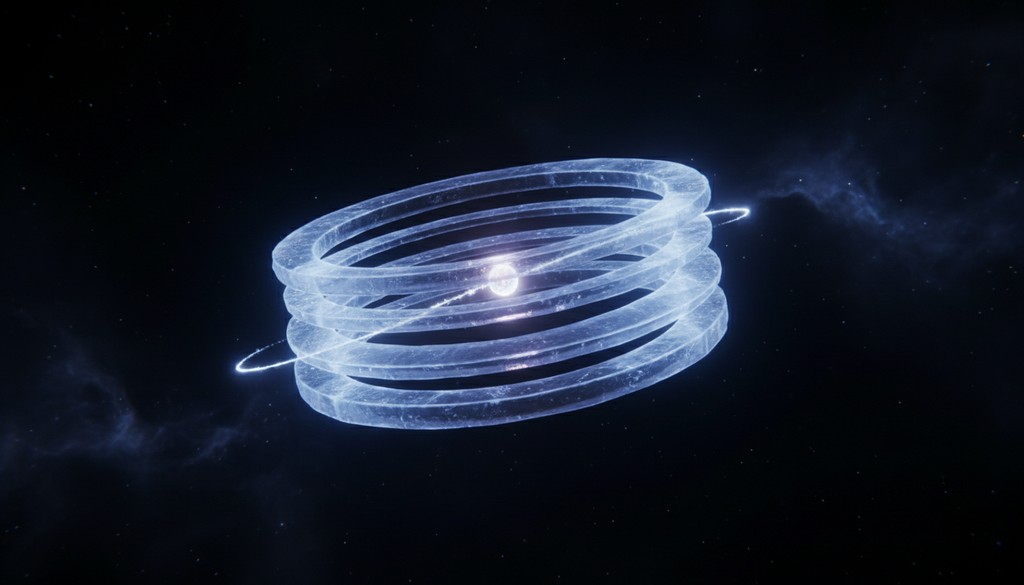
Imagine a standard coin on a table. In the world of classical computing—the kind that powers your phone—that coin is either heads (a 1) or tails (a 0). It is a bit, and it can only be one thing at a time. Now, imagine spinning that coin on the table. While it is spinning, is it heads or tails? It is actually a blur of both! In quantum physics, we call this superposition. Instead of being stuck as a 0 or a 1, a quantum bit, or qubit, exists as a combination of both states simultaneously, as explained by ↗quantum-inspire.com. This allows a quantum computer to explore a vast map of possibilities all at once, rather than checking them one by one like a person lost in a maze.
The Invisible Connection
There is another trick up the quantum sleeve called entanglement. Think of two magic dice: if you roll one in London and it lands on a six, its partner in New York will instantly show a six too, no matter how far apart they are. As ↗ibm.com notes, when qubits become entangled, their states are perfectly correlated. This isn't just a party trick; it allows qubits to work together in a massive, unified team. This collective power grows exponentially. While a normal computer adds power bit by bit, a quantum computer doubles its potential with every single qubit we add to the system.
Why This Changes Everything
You might wonder why we need this much power. The answer lies in the complexity of nature. According to ↗quantumzeitgeist.com, these machines are uniquely suited for simulating the behavior of atoms and molecules. This means we could:
- Design new medicines by simulating how drugs interact with our cells at a molecular level.
- Create super-materials that are stronger, lighter, or better at conducting electricity.
- Solve massive puzzles in logistics and climate science that would take today's supercomputers thousands of years to crack.
When we finally measure a qubit, it "collapses" from its spinning blur into a solid 0 or 1, giving us the answer to our calculation. We are currently learning how to keep these delicate spinning coins from wobbling, a challenge known as decoherence, but the progress is rapid. We are moving toward a future where the impossible becomes a standard Tuesday afternoon calculation.